FAIR USE NOTICE

Bear Market Economics (Issues and News)

FAIR USE NOTICE

This site may contain copyrighted material the use of which has not always been specifically authorized by the copyright owner. We are making such material available in an effort to advance understanding of environmental, political, human rights, economic, democracy, scientific, and social justice issues, etc. we believe this constitutes a ‘fair use’ of any such copyrighted material as provided for in section 107 of the US Copyright Law.

In accordance with Title 17 U.S.C. Section 107, the material on this site is distributed without profit to those who have expressed a prior interest in receiving the included information for research and educational purposes. For more information go to: http://www.law.cornell.edu/uscode/17/107.shtml

If you wish to use copyrighted material from this site for purposes of your own that go beyond ‘fair use’, you must obtain permission from the copyright owner.

FAIR USE NOTICE FAIR USE NOTICE: This page may contain copyrighted material the use of which has not been specifically authorized by the copyright owner. This website distributes this material without profit to those who have expressed a prior interest in receiving the included information for scientific, research and educational purposes. We believe this constitutes a fair use of any such copyrighted material as provided for in 17 U.S.C § 107.

Read more at: http://www.etupdates.com/fair-use-notice/#.UpzWQRL3l5M | ET. Updates
FAIR USE NOTICE FAIR USE NOTICE: This page may contain copyrighted material the use of which has not been specifically authorized by the copyright owner. This website distributes this material without profit to those who have expressed a prior interest in receiving the included information for scientific, research and educational purposes. We believe this constitutes a fair use of any such copyrighted material as provided for in 17 U.S.C § 107.

Read more at: http://www.etupdates.com/fair-use-notice/#.UpzWQRL3l5M | ET. Updates

All Blogs licensed under Creative Commons Attribution 3.0

Sunday, September 6, 2015

Why You Need to Understand Evangelical Christianity's Outrageous and Influential Far-Right Fringe


Home


BELIEF
Its followers believe the Bible, and the laws contained within it, should rule over every aspect of life.

Here's a simple question: Have you ever heard of Christian Reconstruction, Rousas J. Rushdoony, or one of his most influential works, The Institutes of Biblical Law? Probably not! Christian Reconstruction, is a religious belief system, set out by the late Rushdoony, which maintains that every aspect of society – church, state, family, economy -- should be based on Biblical law. It is evangelical Christianity's right-wing fringe, yet its tentacles reach deep into the Clown Car that is the Republican Party's field of presidential candidates. Is Christian Reconstruction so fringed out that it is not worthy of attention? Not according to Julie J. Ingersoll, author of the new book, Building God's Kingdom: Inside the World of Christian Reconstruction, who posits that Reconstructionists' "biblical worldview" played, and continues to play, a highly influential role, although subtle and often hidden, in contemporary right-wing politics.
When Christian Reconstructionists say God's law -- as it is revealed in the Old and New Testaments -- should control every aspect of life, they mean every aspect, interpreting the Bible as mandating a challenge to the legitimacy of democracy, justifying slavery, and advocating the stoning to death of homosexuals, adulterers, and Sabbath-breakers. If any of this sounds familiar, you might be thinking Taliban and/or ISIS.
As investigative reporter John F. Sugg pointed out in a 2004 extensive piece in Tampa, Florida's Weekly Planet, "Most churchgoers have never heard of Christian Reconstruction or theonomy. Believers would be hard-pressed to define 'dominion theology,' 'covenant theology,' 'pre-millennial,' [or] 'post- millennial.' ... Nor would most Americans reflexively embrace a 'theology' that denounced all government social programs, public schools, environmental protections -- a religion that promoted mass executions for sins as minor as swearing at parents, ..."
While a number of investigative reporters, researchers and writers such as John Sugg, and Chip Berlet, author of Eyes Right! Challenging the Right Wing Backlash, and Frederick Clarkson, author of Eternal Hostility: The Struggle Between Theocracy and Democracy, have delved deeply into this movement over the years, perhaps no one has been as immersed in it as Ingersoll.
In the Preface to Building God's Kingdom: Inside the World of Christian Reconstruction (Oxford University Press, 2015), Ingersoll, an Associate Professor of Religious Studies at the University of North Florida, writes that she first encountered Christian Reconstruction in the early 1980s during and after her days at Rutgers University.
Steeped in the conservative movement, Ingersoll worked as a volunteer, intern, writer and researcher for several of the more significant New Right political organizations of that period, including the National Conservative Political Action Committee, Paul Weyrich's Free Congress Foundation, and the American Life Lobby. She attended campaign schools run by the National Conservative Foundation, the Committee for the Survival of a Free Congress, and the College Republican National Committee Feldman School.
"In 1983," Ingersoll writes, she "married a member of one of the Reconstructionist families," and was divorced in the early 1990s. Although she had differences with many in the movement, mostly over issues related to the treatment of women – she was a supporter of the Equal Rights Amendment – she worked with a number of right-to-life groups, including Operation Rescue, and was the California chapter president of Feminists for Life.
Building God's Kingdom is the result of nearly thirty years of research, writing, reflection, re-thinking, involvement with and detachment from evangelical Christian conservative movements. Ingersoll acknowledges that it is difficult to quantify the influence of Christian Reconstruction on mainstream politics as they have their own institutions and do not readily share their data, therefore leaving "the strategy of trying to trace the[ir] influence in more subtle, nuanced, and admittedly interpretive ways."
Rushdoony: New Right intellectual "godfather"
According to Ingersoll, Rushdoony never received his props: He was one of the religious right's "intellectual godfathers," but he was "often treated like a crazy uncle." Nevertheless, while Recostructionism never attracted "much [grassroots] support ... the movement's ideas became a driving force in American politics," as Reconstructionists "found a home in Washington-based political organizations, such as the Moral Majority and Christian Voice."
Howard Phillips, a major figure in the early development of the religious right called Rousas John Rushdoony the "most influential man of the 21st century" whose work brought about "historic changes in the thinking of countless leaders." Phillips told Ingersoll that Rushdoony was "early and often on all the big issues, and he was a pioneer in the homeschool movement."
On the occasion of Rushdoony's death in February 2001, Gary North, a movement leader and Rushdoony's son-in-law, credited him with "being the source of many of the core ideas of the New Christian Right," and maintained that "the mainstream media" never understood the scope of his influence.
Ruashdoony's appeal to religious right leaders was that he put the Bible at the center of everything. Rushdoony's work permeated "arguments made by conservative Christians about biblical government that focus on the character and structure of families, free-market economics, the legal status of religion, the critique of public education, care for the poor, the right to own guns, the funding of health care."
Ingersoll's Building God's Freedom "address[es] one aspect of the story of the contemporary conservative Christian subculture and the rise of the religious right: the impact of a small group of fundamentalists known as Christian Reconstructionists."
"Well before the establishment of the Washington-based political organizations designed to harness the growing dissatisfaction among conservative Christians," Ingersoll writes, "Reconstructionists were laying the intellectual foundation that would shape the twenty-first century conservative Christian subculture, developing what would become the religious right's critique of the American social order, and plotting strategies to bring about change."
While adherents of the religious right do not make up a majority of this country'spopulation, nevertheless, a substantial number of people believe – as Christian Reconstructionists do -- that America is Christian nation, separation of church and state is a liberal-initiated shibboleth, patriarchy is the God-ordained structure for families, that the Bible, and the laws contained within it, should rule over every aspect of life.
Christian Reconstruction is playing the long game, and Ingersoll meticulously explores its "strategy" of "mak[ing] meaningful the mundane details of day-to-day life by situating them in a sweeping narrative framed as the fundamental purpose of God and his creation." Building God's Kingdom traces the origins of the New Christian Right back to the Old Christian Right; describes how Reconstructionists "helped the movement take root in the conservative Protestant subculture"; and, details how Reconstructionist ideas were planted in evangelical culture, even amongst those that didn't identify with Reconstructionism.
Cyclically, mainstream media's pundits and prognosticators bury the religious right. And while it is worthwhile pointing out that the religious right's influence has ebbed and flowed over the past two decades, some of its issues -- now most famously being played out under the meme of "religious freedom" -- remains at center stage. While Reconstructionists are not responsible for totally birthing the religious right, and have rarely been in the spotlight, nevertheless its "influence continues, although often until recently unacknowledged and sometimes denied."
Bill Berkowitz is a longtime observer of the conservative movement.

Saturday, August 29, 2015

Christian Democrats of America Say Republican Dominance of Christianity Ending


PoliticusUSA


Christian Democrats of America Say Republican Dominance of Christianity Ending


Saturday, August, 29th, 2015, 8:03 am


flag cross elephant


We are hearing again that “the Republican Monopoly on Christianity is Nearing its End” – in other words, that the Religious Right is finally losing its grip. That is what Christian Democrats of America’s Executive Director, Christina Forrester is telling us. I hope so. It is past time Christians stood up to the bullies in their midst, the people who have hijacked their religion since the 1970s to the sound of crickets.

Yet far from surrendering, there are signs the Religious Right, like Fox News, is getting behind Donald Trump, who, like actor Christopher Walken, is a genre unto himself. The difference is, Walken amuses us by pretending to be scary people on film, while Trump would be more amusing if he wasn’t pretending.

Is Donald Trump as a sign of just how deeply the Religious Right has permeated Republican politics, or is he evidence of its demise? Is he a sign of the end of the Religious Right’s dominance, that they have had to settle on a candidate who openly pooh-pooh’s the doctrine of repentance, who reduces the Eucharist to a “little wine” and a “little cracker”?

Or is he a sign of the Religious Right’s resilience and its chameleon-like ability to endlessly reinvent itself? It’s no small thing, after all, to have openly promoted hypocrisy through word and deed for almost 50 years while still successfully maintaining the moral high ground.

The obituary of the Religious Right has been written many times over. To confront such claims in 2012, Ed Kilgore wrote in theNew Republic in 2012 that “The Political fumbling by Christian conservatives has been even worse this presidential cycle than it was in 2008.”
Kilgore pointed to the selection of John McCain, their enemy, in 2008, and says of 2012, “The Christian Right’s fatal failure this time was its inability to form a consensus behind a single candidate.”

However, he concluded that,
But if it’s entirely fair to point out that the once-indomitable Christian Right has botched the contest for the 2012 Republican presidential nomination, it’s another thing altogether to conclude…that the Christian Right’s days of national influence have finally expired.
He is right. On each occasion, the rumors of its death have been proven wrong. And this is exactly what Bill Berkowitz pointed out in Religious Dispatches in June of 2009 that “even after an Obama victory reports of the death of the Religious Right are greatly exaggerated.”
And Dan Gilgoff, writing in U.S. News & World Report, argued in April 2009 that “for a movement on the verge of collapse, the Christian right ain’t doing too bad so far as influencing policy goes,” and pointed to its “29-to-0 record in amending state constitutions to ban same-sex marriage” as evidence.

Kilgore, far from admitting defeat, claimed victory: “But if they haven’t been able to pull their muscle behind a single candidate, that’s not a sign that they are on the wane—it’s a sign that, as far as the Republican Party is concerned, they have already won.”
So yes, Americans would be justified to be skeptical of any such claims. But let’s look at the argument.

According to Forrester, there are “key indicators that Christian votes will begin to lean more democratic in the 2016 Presidential election and beyond.”

1. Wedge issues have gone awry. The Republican Party’s two “clinch” issues–gay marriage and abortion–are becoming less of a factor for voters. While many Christians, regardless of their political affiliation, may be pro-life and in favor of traditional marriage, the tone of the conversation has changed dramatically and is no longer becoming a singular or even primary influence in picking a candidate. And with the recent Supreme Court decision, one could argue the fight for “traditional marriage” is now truly a moot point. One recent high-profile report even underscored that “most Republican presidential candidates seem to want to avoid talking about the issue [all together]—as Mitt Romney largely did in 2012.” Another 2015 report underscoring “The Republican Party’s Abortion Bind” cites that, despite “a newly enormous majority in the House and a newly minted majority in the Senate, Republicans finally had a chance to get a bill to the president,” but to no avail as the GOP coalition fell apart on technicalities in its attempt to pass a new bill. The report further highlights part of the challenge for Republicans, citing that “everyone knows the GOP faces a demographic time bomb, since its voters are older and whiter and more pro-life than the general population, so it’s risky to do anything that might make it harder to win them over.” Further, polling has shown that “the majority of Americans, based on gender, do not let their views on abortion affect their choice in a presidential candidate.” That finding reportedly came shortly after Rep. Todd Akin, the then Republican Senate hopeful from Missouri, drew backlash from his own party for his comments regarding “legitimate rape” and abortion.

2. “Compassionate conservatism was a lie.” In 2000 when George W. Bush ran for President, he won based on the assurance of a softer, more holistic conservatism that promised to leave “no child left behind” and to be more inclusive of groups across varied economic backgrounds. Fast forward to today and only a few voices in the Republican party are discussing economic equality. Indeed, the Republican party is still not only perceived as the party of the wealthy, but duly anointed as outlined in a March 2015 report titled “The Fight for the Soul of the Republican Party Is Over: The Rich Won Again” that detailed the epic failure of “reform conservatives” striving to reconnect the party to middle-class and low-income voters. Terms such as “The War on the Poor” and trending Twitter hashtags like #GOPWaronthePoor #WaronthePoor show that more and more Americans, and Christians, are identifying the Republican party with the wealthy, the so-called 1%, and against policies to help the poor. The GOP has not helped itself in this regard by allowing members of Congress and outspoken Evangelical leaders to leverage the media with messages that insult or demean food stamp recipients and others in the low economic class. When every policy, from the subsidized “Obamaphone” program to budgets for food stamps, which assists our nation’s poor, is slammed by the GOP establishment, the people, including Christians, are finally starting to take notice. This is especially true in states where GOP governors have refused the expansion of Medicaid under the Affordable Care Act, which would help millions in their states be able to receive healthcare. The effect of the GOP general narrative on helping these millions of poor families is especially heard…and felt. This is especially noticed by Christians who identify Jesus’ teachings of helping the poor and what our attitudes should be towards the needy. More and more Christians are identifying as Democrat or Liberal simply because they can no longer justify supporting the Republican party, based on these issues. As a result, we are seeing a rise in “pro-life Democrats” who are for abortion restrictions, but also broaden their definition of “pro-life” to all people in all phases of life, as scripture indicates. In this case, anyone classed as “the least of these” is a pro-life concern.

3. Christian Millennials are progressive-minded. In 2012, 67% of those under 35 voted for Obama. Since 62% of Millennials under 35 also identify with some form of Christianity, it stands to reason that there are millions of Millennial Christians who are progressive minded (or hold progressive values). Even though Republicans saw victory in the midterm elections, progressive ballot items won by a landslide, and Millennials voted in line with those items. Millennial Christians are also more inclined to support the LGBT rights movement, gay marriage and civil rights issues. They largely identify with values of compassion and minority issues, which have become known as part of the Democratic platform. Millennials, including Christians, dislike the GOP rhetoric on religious freedom laws and gay rights, women’s rights and minority issues.

Forrester is not the first to make these claims. Georgetown University historian Michael Kazin suggested in 2012 (the claims to which New Republic’s Kilgore was responding) that the Religious Right was “on the wane” because it was “increasingly out of touch with public opinion, and on the wrong side of generational tends.” Kilgore was willing to concede on same-sex marriage but contested Kazin on abortion.

CJ Werleman said much the same on AlterNet in 2014, writing that “The Christian Right’s dirty little secret is they are acutely aware that changing demographics are running against them.” In Werelman’s view, far from being a rumor, even the Religious Right knows it has lost the culture war.

Over at Bloomberg, Francis Wilkinson of the editorial boardlooked to the Academy Awards, of all places, for evidence of the rout: the 2014 selection of openly lesbian Ellen DeGeneres as “the safe choice to host one of the most mainstream, popular television events of the year, watched by some 40 million Americans.”

Wilkinson opined that while the rest of us have come to grips with “gay equality” and that “Religious conservatives will take a little longer not because they are religious, but because they are conservatives.”

Kazin wrote in January 2012,
Every GOP candidate still in the race speaks of Planned Parenthood as if it were a band of terrorists and vows to stop the largest and oldest reproductive rights group in the country from winning even a dollar of federal funding—and all of them except Ron Paul has signed a firm pledge to support a constitutional amendment that would essentially ban same-sex marriage.

As we well know, because of some faked videos, the assault on Planned Parenthood, three years on, is far from over – or won. The simple fact is that if Republicans gained the Senate, they lost the White House – again. For conservatives it is a simple matter formula of “Planned Parenthood = abortion” but Obama has proven himself a strong champion of women’s rights – including reproductive rights. And Democrats in Congress, many of them women, have stood firm against conservative efforts to give men authority over their bodies.
And the pledge against same sex marriage…well, we saw howthat turned out, didn’t we? Kilgore was right to concede in 2012. The Supreme Court has spoken. If corporations are people, so are gays and lesbians, and as such, they have the same rights to marriage as “heterosexuals.”

Kazin said liberals had won another culture war issue too: contraception, pointing out that “The news that the traditionalist Catholic ex-Senator from Pennsylvania [Rick Santorum] had suggested that contraception ‘is counter to how things are supposed to be’ was enough to bury under a heap of ridicule whatever slim chance he had to win the nomination.”
Kilgore’s conclusion is my longstanding conclusion: “The Christian Right has been buried many times by secular observers since its advent as a powerful political movement in the late 1970s. It’s far too early to write yet another obituary.”

That isn’t to say that it isn’t on a wane. Take heart. Forrester makes some valid points. Mainline Christians have begun to organize and to speak up, for example, with regards the Iran nuclear deal, and against war. We even have a Pope standing up to the Religious Right.

However, demographics or not, Christians have not seized the mantle from the Religious Right. It may be coming, but it’s not here: The struggle is about more than the White House, despite the Religious Right’s victory in 2000, putting George W. Bush in the Oval Office.
It has always been so: it is about communities; towns and cities, and fifty states and their state legislatures, their governors, and their representatives in Congress.

These are the areas where the Religious Right still dominates. In “Jesus welcomes you to” signs at the edge of small-town America, and Ten Commandments displays in courthouses; in charter schools that teach religion, and public school textbooks that teach creationism rather than science to our children.

Evidence of the end of Republican dominance of Christianity will be in the form not of a Democratic presidential victory, which is almost assured, but success in these local elections, and the advent of true religious freedom for all Americans over the Religious Right’s imposition of religious tyranny.


I’ll believe the Religious Right is dead when I see it lying in the road.

Sunday, August 16, 2015

These religious clowns should scare you: GOP candidates’ gullible, lunatic faith is a massive character flaw

SALON


These religious clowns should scare you: GOP candidates’ gullible, lunatic faith is a massive character flaw


Their deluded debate answers removed any remaining doubt: These kooks belong nowhere near the White House


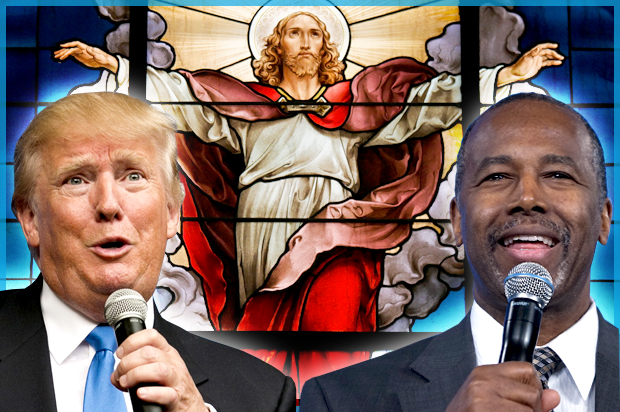
These religious clowns should scare you: GOP candidates' gullible, lunatic faith is a massive character flawDonald Trump, Ben Carson (Credit: Reuters/Dominick Reuter/Rick Wilking/jorisvo via Shutterstock/Salon)

One of the most serious problems with religious faith is that it can afflict an otherwise intelligent person and incite her to utter arrant inanities with the gravitas of an old-time, Walter-Cronkite-style television newscaster. This problem is doubly striking when that intelligent person is herself a newscaster (of sorts). And triply striking when that newscaster (of sorts) is Megyn Kelly, the Fox News star who looks sane amid a roster of crazies headed by the faith-addled duo of Sean Hannity and Bill O’Reilly. Kelly is purportedly a Roman Catholic, but judging by her racy photos, divorce, and remarriage outside the church, the Pope and his bull(s) don’t play much of a role in her life. All of which is good, in my view.
Nonetheless, as the recent Fox News Republican presidential debates were coming to an end, Kelly decided to extract a (patently ridiculous) religion-related question from her channel’s Facebook feed and give it air time. Prefacing it by calling it “interesting,” she put the query to the politicians assembled on stage directly and in all seriousness: “Chase Norton on Facebook . . . wants to know this of the candidates: ‘I want to know if any of them have received a word from God on what they should do and take care of first.’” She paused. With just a hint of insouciance, and in one of the most understated segues I’ve ever witnessed, she then asked, “Senator Cruz, start from you. Any word from God?”
Now let’s pause and consider the situation. Kelly is a political science graduate from a major Northeastern university, an attorney by trade with some 10 years of practice behind her, and a citizen of one the planet’s most developed countries. Speaking on satellite television (a technological wonder, whether we still recognize it or not, and no matter what we think of Fox News) in the twenty-first century, this sharp, degree-bearing professional American has just asked, with a straight face, a senator (who happens himself to be a magna cum laude graduate of Harvard Law) if he is receiving messages from a supernatural being. Yet no one in the audience broke into guffaws or even chuckled. And, of course, no one cried out with irate incredulity at the ludicrousness of the supposition implicit in the question (that an imaginary heavenly ogre could possibly be beaming instructions down to one of his earthling subjects). But since the supernatural being in question goes by the name of “God,” in the clown show that was the Republican debate, everyone – audience, MC, and the clowns themselves – simultaneously took leave of their senses and judged the matter at hand legit.
In any event, the question gave Cruz the chance to display his bona fides as a faith-deranged poseur. He told us, to waves of applause, that he was “blessed to receive a word from God every day in receiving the scriptures and reading the scriptures. And God speaks through the Bible.” He reminded us that his truant, once-alcoholic father had found Jesus and returned to the family; that he supports the sickening array of Religious Freedom Restoration Acts now pullulating pestilentially across the land; and that he’s against Planned Parenthood. Nothing new or even interesting here. Referring to conservatives, he noted that “the scripture tells us, ‘you shall know them by their fruit.’” Well, we know Cruz’s fruit, and it is poison to the cause of Enlightenment.
Kelly then turned to John Kasich, who, punctuating his speech with a strange mix of karate chops, head wobbles, and thumb-wags, brought up his family’s immigrant background and implied his election as Ohio’s governor was a miracle, but, oddly, did so without really implicating the Lord in it. He rambled on (godlessly) about the need for unity and respect, giving us reason to think – and this is a good thing – that he considered the issue of religion too divisive to dilate upon. He finally, though, did answer Kelly’s question: “In terms of the things that I’ve read in my lifetime, the Lord is not picking us. But because of how we respect human rights, because that we are a good force in the world, He wants America to be strong. He wants America to succeed.” This bland verbiage prefaced his closing non sequitur: “Nothing is more important to me than my family, my faith, and my friends.”
Given that he is a biblical literalist and believes he is destined for heaven, and that why Kasich chose to pass up the chance to spout piety is a mystery.  However, he (grudgingly) recognized the Supreme Court’s ruling in favor of same-sex marriage; quite possibly, he is content with leaving faith out of public affairs.  Just as the Constitution would have it.
Wisconsin governor Scott Walker spoke next. He admitted to being an “imperfect man” and straightaway proved it by claiming to have been redeemed of his sins “only by the blood of Jesus Christ.” Walker’s father is a Baptist preacher, and he himselftook to the pulpit as a teen, so such language should hardly surprise us. But before you dismiss it as boilerplate Jesus jabberwocky, consider that it does serve to highlight the bizarre conceit of the Christian cult: that the good Lord could think of no other way to give us a boost a couple of millennia ago except by orchestrating a cruel, ghastly act of human sacrifice involving His own kid. (Some dad.) If nothing else, ghoulish talk of this sort should prompt Fox News post-factum to rate the entire debate NOT SUITABLE FOR MINORS, or, at the very least, VIEWER DISCRETION ADVISED.
(And where are all those annoying trigger-warning zealots when you need them? Why don’t they campaign to have the Bible stamped with “TRIGGER WARNING: contains multiple accounts of genocide, warfare, murder, enslavement, sexual abuse of women and underage girls, and ritual human and animal sacrifice”?)
In any case, Walker returned to reality, if only for a brief sojourn, and said the Lord hasn’t vouchsafed him a plan of action, and “hasn’t given me a list, a Ten Commandments, if you will, of things to act on the first day.” He closed saying he planned to live his “life in a way that would be a testimony to [God] and our faith.”
On this latter point journalists may wish to ask Walker to be more specific. Since he had just mentioned a bloody, barbaric, public act of execution and its lasting salvific effect on him, we are well within our rights to demand what sort of form his “testimony” will take. He has two sons. Might he consider offering at least one of them as a participant in one of the Philippines’ horrific real-life reenactments of the crucifixion that occur on Good Friday? Perhaps he would like to take part himself? Will he, if elected president, opt to introduce crucifixion as an approved means of execution? According to the Bible, God visited genocide, warfare, exile, slavery, and rape on humanity, and has drawn up plans to destroy the vast majority of us. Which of these banes would a President Walker chose, as part of his personal faith journey, to impose on his fellow Americans? Or would he limit himself to making merely cosmetic changes, such as replacing the White House’s annual National Security Strategy with the Book of Revelation?
Without responding to the Facebook user’s question about God’s to-do list, Senator Marco Rubio sputtered out permutations of bless (noun, verb, and adjective) in pitchman’s prattle too dull to merit space here, and spoke about the need for reform in the Veterans Administration (which Kelly had asked him to address, from the Lord’s perspective, of course). One might have concluded that he hardly believed in the supernatural at all, yet one would, of course, be erring grievously: he attends the extremist Christ Fellowship in Miami, a hotbed of exorcism, creationism and homophobia.
Kelly last turned to Dr. Ben Carson. Perhaps the most disturbing example of how high intelligence and belief in balderdash myths can jointly inhabit a single mind, Carson, so faith-deranged that he denies evolution and has had himself baptized twice, dodged God entirely and offered a reasonable look into how a neurosurgeon sees the issue of race relations. We can only surmise he felt he had elsewhere spoken enough about God. He gained nothing with his audience by leaving the Lord out, but by doing so he at least offered rationalists a tiny respite from the evening’s madness.
Presidential candidates have the constitutionally protected right to profess the religion of their choice and speak freely about it, just as atheists have the right – and, I would say, the obligation – to hold religion up to the ridicule and derision it so richly deserves. In that regard, nonbelieving journalists in particular should give openly devout candidates no passes on their faith. Religion directly influences public policy and politics itself, befouls the atmosphere of comity needed to hold reasoned discussions and arrive at consensus-based solutions, sows confusion about the origins of mankind and the cosmos, and may yet spark a nuclear war that could bring on a nuclear winter and end life as we know it. I could go on (and on), but the point is, we need to talk more about religion, and far more frankly, and now, before it’s too late.
Discussing religion freely and critically will desacralize it, with the result that the public professions of faith of which our politicians are so enamored will eventually occasion only pity, disgust and cries of shame! or, at best, serve as fodder for comedians. Faith should, in fact, become a “character issue.”  
The advances of science have rendered all vestigial belief in the supernatural more than just obsolete. They have shown it to indicate grave character flaws (among them, gullibility, a penchant for wish-thinking and an inability to process information), or, at the very least, an intellectual recklessness we should eschew, especially in men and women being vetted for public office. One who will believe outlandish propositions about reality on the basis of no evidence will believe anything, and is, simply put, not to be trusted.
Come on, rationalist journos, be brave and do your job. Even if Megyn Kelly won’t do hers.
Jeffrey Tayler is a contributing editor at The Atlantic. His seventh book, "Topless Jihadis -- Inside Femen, the World's Most Provocative Activist Group," is out now as an Atlantic ebook. Follow @JeffreyTayler1 on Twitter.

Wednesday, May 20, 2015

Bill O’Reilly’s all-American paranoia: What’s really behind his religion-infused doomsaying


SALON


Bill O’Reilly’s all-American paranoia: What’s really behind his religion-infused doomsaying


The Fox New host is convinced of this country's imminent moral collapse--but none of his frantic tirades make sense


Bill O'Reilly's all-American paranoia: What's really behind his religion-infused doomsaying 
 
Bill O'Reilly (Credit: Reuters/Brendan Mcdermid)
 
 
Last week, Bill O’Reilly let it all out in one of his most bizarre rants of late, discussing what he sees as the moral decline of America, and the imminent fall of our empire — much like the way of the Romans.

He said:
“Any student of history knows that when a nation turns inward toward the pursuit of individual gratification, the country is in trouble. Rome [is) the best example. The citizens there ultimately rejected sacrificing for their republic…and the empire collapsed.”
O’Reilly is certainly correct about the decline of the American empire — the ship is sinking, but not for the reasons he seems to think. The Fox News host attributes our impending fall to a moral decline, which to him, of course, means the decline of Christian faith. In some fresh new Pew polls, it was revealed that Christian affiliation in America has continued to drop, while the percentage of unaffiliated (including atheism and agnosticism) has gone up a whopping 6.7 percentage points since 2007. Protestant affiliation dropped by 4.8 percentage points, while Catholicism dropped by 3.1 percentage points.

To O’Reilly, this signals a moral decline in America, a harbinger of our ultimate collapse. The reason for such a dire assumption is simple: O’Reilly, and a significant part of the population, believes that atheism, or any kind of doubt, is synonymous with nihilism. This comes from a presumption that religion is the ultimate moral guide, and without it, human beings are morally bankrupt. As one character famously remarked in Dostoyevsky’s novel “The Brothers Karamazov”:

“If God does not exist, everything is permitted.”

Predictably, O’Reilly attributes the rise in disbelief to things like drug abuse, rap music and the liberal media:
“There is no question that people of faith are being marginalized by a secular media and pernicious entertainment. The rap industry for example often glorifies depraved behavior and that sinks into the minds of some young people, the group that is most likely to reject religion. Also many movies and TV shows promote non traditional values.”

This view is hopelessly naive, and once again sprouts from the assumption that atheism and nihilism are synonymous. It is inconceivable to O’Reilly that the rise in non-affiliation is more likely because of education and the rejection of unprovable myths than because of a moral decline. Even William Jennings Bryan, nearly a century ago, understood that education and scientific advancement were causes for rejection of faith, saying of schoolchildren at the famous Scopes Trial: “If they believe (in evolution), they go back to scoff at the religion of their parents.” The more one understands the natural world, the more likely they are to reject the myths of their parents.

What makes O’Reilly’s conjecture truly insulting is his assurance that non-religious people are somehow more likely to be immoral. This shows not just a remarkable measure of O’Reilly hypocrisy — if increasingly dire reports on his personal life are to be believed — but also his ignorance of history. Before the modern era, it was more or less illegal to be an atheist in the Western world; the further we go back, the more violence rises, as documented in Steven Pinker’s “The Better Angels of Our Nature.” Today, violence is the lowest it’s been in documented history, while religious disbelief is presumably at its highest point.
In his book, Pinker describes what he sees as the likeliest causes of this humanitarian revolution:
“The growth of writing and literacy strikes me as the best candidate for an exogenous change that helped set off the Humanitarian Revolution. The pokey little world of village and clan, accessible through the five senses and informed by a single content provider, the church, gave way to a phantasmagoria of people, places, cultures, and ideas.”
The rise in literacy and education, along with the centralized state, have contributed to the most peaceful and moral era in history — not religion. Furthermore, studies have found that non-belief is more common in wealthy industrialized societies and that rates of the most violent crimes tend to be lower in less religious states. Another report shows that just 0.2 percent of America’s prison population is atheist, while more than half are Catholic or Protestant.
What does all this reveal? Not that atheists or Christians or Buddhists are more or less moral; but that human beings exist in a complex moral landscape, shaped by any number of factors; and that the environment one grows up in plays a crucial role in developing this morality. So, Bill O’Reilly’s fear that the drop in Christianity is contributing to a moral crisis, and that this moral crisis in contributing to the imminent collapse of the American empire, is hogwash.

But this doesn’t mean he’s entirely incorrect about that impending collapse.
Indeed, the American empire that was built up during the 20th century does seem to be heading toward a decline; but it is not because of some great moral crisis. In fact, the moral crisis that O’Reilly attributed to the lack of religion is really just a natural result of our economic system. O’Reilly says “pernicious entertainment” is causing this collapse; but in reality, this entertainment is simply the result of the consumer society, which emerged during the latter half of the 20th century, after capitalists and corporations found that all the basic needs and wants of the people had been satisfied. An entire industry of advertising and marketing was born to create new and increasingly specialized (and often pointless) needs. This grew out of the system of capitalism — the very system that O’Reilly loves so dearly.

When O’Reilly praises the capitalism, he is praising the old Protestant ethic that Max Weber wrote about. But that capitalism is gone, and today we live in what naturally forms from that ideal. So, if there is anything that can truly be blamed for the moral ills that O’Reilly is so concerned about, it is our economic system, based on materialism and self-interest. Ironically, this O’Reilly-backed free-market impetus may very well be a major contributor to our fall.

The United States has been importing and consuming more than it has produced and exported for many years now, and this is simply unsustainable. When a country’s citizens  put everything on credit to satisfy their ridiculous consumption, a fall from grace is bound to occur. This happened in the late 2000s, when the housing bubble collapsed, and there is no reason to think it can’t or won’t happen again in the future.

The reality is that the American empire will collapse (barring some miraculous act of God responding to the prayers of O’Reilly), and another empire will likely take its place, just as it always has throughout history. It is also possible that there will be no new empire equatable to modern America, and instead regional powers. Regardless, O’Reilly and his followers will blame this fall from superpower status on the decline of faith and moral decay, because they like to think that America is somehow special; that we are God’s chosen ones. But that is childish, and childish fantasies will only accelerate this inevitable decline.

Follow Conor Lynch on Twitter at @dilgentbureauct

Wednesday, May 6, 2015

The Invention Of Christian America

Digg


ONE NATION, UNDER GOD?

“Christian America” was born. Not in 1776, but in the mid-20th century. Kruse and I talked about how that happened, why it matters, and what it means for the story we tell ourselves about our country. 


ONE NATION, UNDER GOD?

The Invention Of Christian America


They say politics makes strange bedfellows, but if you were to hear that wealthy businesspeople have taken up with conservative Christians, you probably wouldn’t be too surprised — just think of Hobby Lobby. Has it always been thus? Not according to Kevin Kruse, Princeton historian and author of One Nation Under God: How Corporate America Invented Christian America. Per Kruse, the cozy relationship is more recent than many of us might think.

After all, it wasn’t until 1954 — over 175 years after our nation’s founding — that “under God” was added to the Pledge of Allegiance. Two years later, “In God We Trust” became the official American motto. This move toward national religiosity wasn’t, as some1 have assumed, borne entirely out of a response to the godless Communists. Kruse’s book argues that the notion of a Christian America — a country not just comprising Christians but fundamentally Christian in its structure, nature, and history — was cobbled together in the 1930s and '40s by a group of businessmen and ministers who needed each other to unite against a common enemy: FDR and the New Deal. 

The Great Depression saw the revival of public interest in the Social Gospel — the idea that Christianity ought to be more concerned with the common good than individual salvation. Businessmen like J. Howard Pew (of Sun Oil) and Harvey Firestone didn’t like the emphasis on what they saw as “collectivism,” so they decided they needed to partner with a group of likeminded individuals who would help them advance their capitalistic agenda. Who to turn to? 

Reverend James Fifield was especially beloved by his flock — First Congregational Church in Los Angeles — and was the free enterprise-loving clergy that Pew, Firestone, and their cohort needed. Through leaning on an organization called Spiritual Mobilization, Fifield and these wealthy corporate leaders helped ministers to see how the domestic support of FDR’s New Deal, which Fifield and others saw as creeping progressivism, was more than just a political nuisance — it was a spiritual threat. Their fear was the emphasis on collectivism, which religious leaders argued diminished the importance of the individual as presented in the gospel of Jesus Christ, which they saw as elevating personal salvation above communal identity.

Thus “Christian America” was born. Not in 1776, but in the mid-20th century. Kruse and I talked about how that happened, why it matters, and what it means for the story we tell ourselves about our country.

One thing I always wonder about is how do you, as an historian, get to a place where you can put a stake in the ground on this issue? What preponderance of evidence do you have to reach before you think, “Okay, I can confidently draw not just a connection but sort of a conclusion?” 

In some ways it’s always a leap of faith. You reach a certain tipping point where you feel that you’ve got several sources all saying the same thing and no one pushing back the other way, you can kind of assume that that’s the case. So I go down into the private letters of the organizations that were pushing this, the private letters of the corporate figures who were funding it, beyond the public statements — if you look behind the scenes, they’re very clear about why they’re doing this.

Are there moments that stand out to you that do this in the book?

Spiritual Mobilization had this radio program, “The Freedom Story.” They started off only talking about Truman, because that’s what [Fifield and Pew] cared about. Soon enough, though, their lawyer says, “You are a public service radio show, and if you weigh too heavily on domestic politics, we’re going to lose that public service designation. So let’s instead talk about the foreign manifestations of communism, and then you can draw some connections to it at home.” Behind the scenes you can see their motive in this; they’re talking about communism abroad in order to attack the creeping socialism at home — to make the New Deal seem like it’s part of this global communist menace.

I read somewhere else about how you didn’t set out to write this book — you set out to write something different about conservative Christianity. What did you find in your research that was big enough to make you change course?

I did a lot of research for what I thought would be my second book, and dove into the papers of Hugo Black at the Library of Congress — he wrote the decision in Engle v. Vitale, which is the school prayer decision of 1962.2  He got at least ten boxes full of angry letters about the decision. What struck me is that in these letters that were written to him, there was a recurring theme: Over and over again, in hundreds if not thousands of these letters, I saw ordinary Americans tell this Supreme Court justice he’d misread the First Amendment, because our national motto is “In God We Trust.” But that had only been made the national motto six years earlier.

Are Christians aware of this history, or is it something new to them? Are we like Anne Hathaway in The Devil Wears Prada when Meryl Streep schools her about the color of her sweater, unaware of the past? 

Christians and everyone, really, even historians, get this wrong. You can look back to plenty of religious invocations the Founders make, but on the issue of whether America is a Christian nation, [the Founders] are very explicit. The Declaration of Independence attributes rights to the Creator, but the Constitution is very clear; there’s no religion other than a date made in the year of our Lord. It keeps religion at arm’s length.

With The Treaty of Tripoli in 1797, you might as well have the Founders of the United States come back and talk to you directly: “The government of the United States is in no sense founded on the Christian religion.” That’s not a statement I think you could make in the '50s or even today, but it was begun by Washington, signed by John Adams — the most religious of the founders — and passed unanimously by a voice vote in the Senate. It was largely uncontroversial at the time. It would not be today. 

If you asked Americans today if we are a Christian nation, they invoke these phrases and this recent history as evidence that yes, we always have been a Christian nation. And that, I think, is a mistake that not just Christians but I think all Americans make.

Have you seen anything good come out of the relationship between corporate America and Christian America? Or has it been all bad?

Ultimately, there have been some positive effects of this language on America. It was not what the corporations intended: Dwight Eisenhower decoupled religious language from Christian libertarianism and it became more inclusive. 

You see this in the civil rights movement. I don’t talk about this in the book, but Martin Luther King, Jr. and others like him are incredibly effective at using this fusion of religion and Americanism and making it clear that segregation can’t fit as part of this. They mobilize this language against segregation.

This is such a white movement in so many ways — the connection between large corporations and Christian America. The people in power are white men. So it’s interesting that some of the civil rights movement was influenced by this rhetoric.

This is a story full of unintended consequences and I think that’s one. Without the groundwork of that fusion of piety and patriotism, you wouldn’t have ministers like King at the forefront of the movement with the language of a religiously-infused Americanism. King calls attention to the founding documents and says, all we’re asking you to do is stay true to what you put down on paper.

In my experience, some of contemporary evangelical Christianity is really this sort of nostalgia for the 1950s, when a woman was a woman and a man was a man. That notion runs throughout the book, too, in terms of people looking backwards toward the era of the Founding Fathers. How has nostalgia been deployed as a political and religious tool?

I don’t talk about it in the book, but one of the later “Freedom Stories” on the radio, they would have Thomas Jefferson travel through time to the ‘50s, furious about the idea of a welfare state. He’s livid and wants to go fight people and rouse an army. So there is a constant looking to the Founders to make these arguments, and all sides do that now. 

But your point about the ‘50s is fascinating, because as we look back to the Founders, I think people who do so very selectively pick out what they like about that era. So if you went back and there were traditional gender roles, where the husband works and the wife stays home and takes care of the family — why is that possible? This is an era in which union levels are at an all-time high. This is an era in which the economy is greatly expanded under Eisenhower, the New Deal state, and the top tax bracket is 92-94 percent. There is a lot on the policy side that makes that familial relationship possible that we just don’t think about.
There are obvious downsides to the ‘50s, too — I mean, we talked about segregation, that’s clearly one of them; gender roles, the rights of gays and lesbians. There’s a lot we would not want to go back to. In some ways, we’re all kind of cafeteria in our approach to nostalgia. You pick and choose parts at will, but you can’t have one part without the other.